ApoB vs LDL: Why Particle Count Predicts Heart Disease Better Than Cholesterol
Standard LDL cholesterol misses half of all cardiovascular events. ApoB measures the actual number of artery-clogging particles. Learn why it matters and what your numbers mean.
Summary
LDL cholesterol — the "bad cholesterol" measured on virtually every standard lipid panel — is calculated, not measured directly, and systematically underestimates cardiovascular risk in a large fraction of the population. ApoB (apolipoprotein B) measures the actual count of atherogenic lipoprotein particles that enter arterial walls and initiate plaque formation. Each LDL, VLDL, IDL, and Lp(a) particle carries exactly one ApoB molecule, making ApoB a direct count of all particles capable of causing atherosclerosis. Research from the MESA trial, AMORIS study, and multiple meta-analyses consistently shows that ApoB outperforms LDL cholesterol in predicting future cardiovascular events — particularly in people with metabolic syndrome, insulin resistance, obesity, or diabetes, where discordance between LDL-C and particle count is most pronounced. This article explains the biology, the discordance problem, and what to do with your ApoB number.
Understanding Lipoproteins: The Real Story
Cholesterol is a fat-soluble molecule that cannot dissolve in blood. To be transported through the bloodstream, it must be packaged into lipoprotein particles — spherical vehicles with a fat-soluble core (cholesterol esters, triglycerides) and a water-soluble outer shell made of phospholipids and proteins called apolipoproteins.
The major lipoprotein classes:
| Particle | Primary Cargo | Apolipoprotein | Atherogenic? |
|---|---|---|---|
| LDL | Cholesterol | ApoB-100 | Yes |
| VLDL | Triglycerides | ApoB-100 | Yes |
| IDL | Mixed | ApoB-100 | Yes |
| Lp(a) | Cholesterol + fibrin | ApoB-100 + Apo(a) | Yes (strongly) |
| HDL | Cholesterol (reverse transport) | ApoA-I | No (protective) |
| Chylomicrons | Dietary fat | ApoB-48 | Minimal (too large) |
The critical insight: every atherogenic lipoprotein particle carries exactly one ApoB molecule. This means a single ApoB measurement counts every LDL, VLDL, IDL, and Lp(a) particle simultaneously. It is a direct particle census.
The Problem with LDL Cholesterol
Standard LDL cholesterol (LDL-C), reported in mg/dL or mmol/L, measures the total amount of cholesterol cargo inside LDL particles — not the number of particles. This distinction is clinically significant because particles of different sizes carry very different amounts of cholesterol per particle.
Large, buoyant LDL particles (Pattern A):
- Carry more cholesterol per particle
- Result in higher LDL-C for a given number of particles
- Less atherogenic per particle (larger size makes arterial wall entry slower)
Small, dense LDL particles (Pattern B):
- Carry less cholesterol per particle
- Result in lower LDL-C for a given number of particles
- More atherogenic per particle (smaller size penetrates endothelium more easily, oxidizes more readily)
In people with metabolic syndrome, insulin resistance, type 2 diabetes, or obesity — extremely common conditions — LDL particles shift toward the small, dense phenotype. This means their LDL-C may look "normal" while their actual particle count (and cardiovascular risk) is significantly elevated.
This is the discordance problem: in individuals with normal or borderline LDL-C but elevated triglycerides and low HDL (classic metabolic syndrome pattern), LDL-C underestimates particle count and therefore underestimates cardiovascular risk.
A major analysis published in the Journal of the American College of Cardiology (Sniderman et al., 2011) reviewed data from six population studies and found that when LDL-C and ApoB were discordant (one was in normal range while the other was elevated), ApoB consistently predicted cardiovascular events better than LDL-C. The direction of discordance mattered: high ApoB with normal LDL-C carried elevated risk that LDL-C missed entirely.
The Biology of Atherosclerosis: Why Particle Count Matters
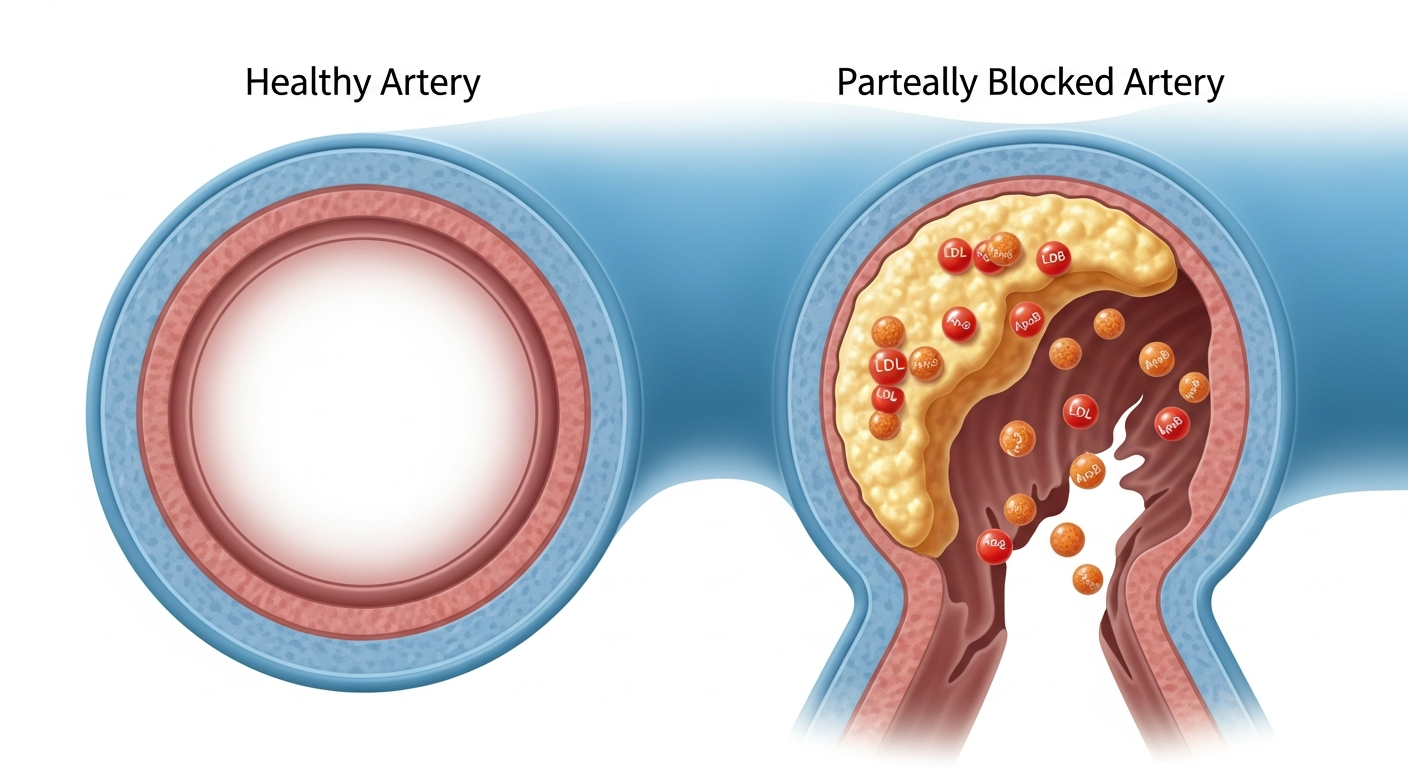
Atherosclerosis — the accumulation of plaque inside arterial walls — begins when LDL and other ApoB-containing particles cross the endothelium and become trapped in the arterial intima. The sequence of events:
- ApoB-containing particles enter the intima: Smaller particles cross more easily; the rate of entry is proportional to particle concentration (number) and size
- Retention in the intima: LDL binds to proteoglycans in the extracellular matrix and becomes trapped — the longer the particle dwells, the more likely it is to oxidize
- Oxidation and immune activation: Oxidized LDL (ox-LDL) is recognized as foreign by macrophages, which engulf it and become foam cells
- Foam cell accumulation: Foam cells form the fatty streak, the earliest stage of plaque
- Plaque progression: Ongoing ApoB-particle infiltration, smooth muscle cell proliferation, calcification, and eventually fibrous cap formation over a necrotic lipid core
- Plaque rupture: If the fibrous cap ruptures, the thrombogenic lipid core is exposed to circulating blood — triggering clot formation and acute myocardial infarction or stroke
The key step is Step 1: entry into the intima. This is proportional to particle number, not cholesterol mass. Ten small LDL particles penetrate the endothelium at a rate that 5 large particles do not — even if both have the same total cholesterol content. This is why particle count (ApoB) is mechanistically the correct metric for atherogenic burden.
Peter Libby, the leading pathobiologist of atherosclerosis, articulated this model comprehensively in his Nature review (2002): "The number of atherogenic particles — best captured by ApoB — is the fundamental driver of atherosclerotic progression."
The Evidence: ApoB vs LDL-C in Predicting Cardiovascular Events
The literature consistently favors ApoB as a superior predictor:
AMORIS Study
The Apolipoprotein MOrtality RISk (AMORIS) study prospectively followed 175,553 Swedes for a mean of 5.6 years. Published in The Lancet (Walldius et al., 2001), it found that ApoB was a significantly stronger predictor of fatal myocardial infarction than LDL-C in both men and women. The ApoB/ApoA-I ratio was the single strongest lipid-based predictor of MI across all subgroups.
MESA Trial
The Multi-Ethnic Study of Atherosclerosis (MESA) measured subclinical atherosclerosis (coronary artery calcium scores) and followed participants for cardiovascular events. Analysis published in the Journal of the American College of Cardiology (Silverman et al., 2016) found that ApoB was more strongly associated with coronary artery calcium progression than LDL-C, and that discordance between the two metrics was common and clinically important.
Emerging Risk Factors Collaboration Meta-Analysis
A meta-analysis from the Emerging Risk Factors Collaboration (Journal of the American Medical Association, 2009) pooled data from 302,430 participants across 68 prospective studies. Non-HDL cholesterol and ApoB were at least as predictive as LDL-C for cardiovascular events, and in discordant cases, ApoB provided independent risk information not captured by LDL-C.
Statin Trials
Notably, statin drugs reduce both LDL-C and ApoB — but the residual cardiovascular risk after statin therapy is better explained by on-treatment ApoB levels than on-treatment LDL-C (Boekholdt et al., 2012, Journal of the American College of Cardiology). Patients who reduce LDL-C substantially but maintain elevated ApoB have worse outcomes than those who reduce both.
Lp(a): The Third Atherogenic Particle Most Doctors Don't Test
Lipoprotein(a) — abbreviated Lp(a) — is a genetically determined lipoprotein found in highly variable concentrations in the population. Lp(a) is structurally similar to LDL but carries an additional protein called apo(a), which inhibits fibrinolysis (clot breakdown) and makes Lp(a) uniquely atherogenic and prothrombotic.
Lp(a) is not routinely measured on standard lipid panels in most countries, yet:
- Approximately 20% of the population has elevated Lp(a) (above 50 mg/dL or 125 nmol/L)
- Elevated Lp(a) increases cardiovascular risk by 2–3 fold, independent of LDL-C
- High Lp(a) causes coronary artery disease in people with otherwise "normal" lipid panels
- A 2022 study in JAMA Cardiology (Björnsson et al.) confirmed Lp(a) as a causal risk factor for MI through Mendelian randomization, with a dose-dependent relationship
Lp(a) carries one ApoB molecule per particle and is captured in the ApoB count. However, because Lp(a) has additional thrombotic properties, it should be tested separately at least once in adult life — particularly if you have premature cardiovascular disease in your family.
Interpreting Your ApoB Number
ApoB is measured in mg/dL. Reference ranges:
| ApoB Level | Risk Category |
|---|---|
| Below 60 mg/dL | Optimal (longevity target per Peter Attia, MD) |
| 60–80 mg/dL | Low to moderate risk |
| 80–100 mg/dL | Borderline to moderate risk |
| 100–120 mg/dL | Elevated risk |
| Above 120 mg/dL | High risk |
The standard clinical guidelines (AHA/ACC 2019 Cholesterol Guidelines) do not yet formally incorporate ApoB as a primary treatment target, but the European Society of Cardiology (2019 ESC Guidelines) explicitly includes ApoB as a target, recommending below 65 mg/dL for very high-risk patients and below 80 mg/dL for high-risk patients.
Many longevity-focused physicians (Peter Attia, MD; Thomas Dayspring, MD; Ethan Weiss, MD) argue the optimal target is below 60 mg/dL for individuals seeking to minimize lifetime cardiovascular risk.
ApoB vs LDL-C discordance: what it means
- Normal LDL-C (below 130 mg/dL) + Elevated ApoB (above 100 mg/dL): Classic metabolic syndrome / insulin resistance pattern. Small, dense LDL particles. LDL-C is misleadingly reassuring. Actual particle burden is high. Treatment indicated.
- Elevated LDL-C + Normal ApoB: Large, buoyant LDL pattern ("Pattern A"). Often a familial hypercholesterolemia variant or benign familial hypercholesterolemia. ApoB suggests lower actual particle burden — risk may be overstated by LDL-C alone.
- Both elevated: High risk; both metrics agree.
How to Lower ApoB
Dietary and lifestyle interventions that reduce ApoB:
-
Reduce dietary refined carbohydrates and sugar: Dietary sugar and refined carbohydrates increase hepatic VLDL production, which elevates ApoB and triglycerides. A low-carbohydrate diet consistently reduces VLDL, IDL, and small-dense LDL — all ApoB-containing particles.
-
Increase dietary fiber: Soluble fiber (psyllium husk, oat beta-glucan) binds bile acids in the gut, reducing enterohepatic bile acid recycling. The liver must synthesize new bile acids from cholesterol, reducing the cholesterol available for VLDL and LDL production. Meta-analyses confirm that 10 grams/day of soluble fiber reduces LDL-C by approximately 5–10% and ApoB proportionally.
-
Reduce saturated fat (especially in the context of high carbohydrate intake): Saturated fat increases LDL receptor downregulation, reducing LDL clearance. The effect is largest on large LDL particles and LDL-C; ApoB reduction is proportional.
-
Exercise and visceral fat reduction: Visceral fat is the primary driver of elevated hepatic VLDL production. Reducing visceral fat through aerobic exercise and fasting reduces VLDL output and, consequently, ApoB.
-
Statins: Reduce hepatic cholesterol synthesis (HMG-CoA reductase inhibition), upregulate LDL receptors, lower LDL-C and ApoB. The NEJM statin trials confirm 15–55% ApoB reduction depending on dose and statin type.
-
PCSK9 inhibitors: Monoclonal antibodies (evolocumab, alirocumab) that prevent degradation of LDL receptors. Produce 50–60% LDL-C reduction and equivalent ApoB reduction. Now indicated for high-risk patients not adequately controlled on statins.
Key Takeaways
- LDL-C measures cholesterol mass, not particle count: In metabolic syndrome and insulin resistance — the most common conditions — LDL-C systematically underestimates atherogenic particle burden and cardiovascular risk.
- ApoB = one molecule per atherogenic particle: A direct count of every LDL, VLDL, IDL, and Lp(a) particle. The most mechanistically accurate measure of cardiovascular risk from lipoproteins.
- Discordance is common and clinically critical: High ApoB with normal LDL-C is the most dangerous pattern — missed by standard lipid panels, predicted by ApoB. Request ApoB with your next bloodwork.
- The AMORIS study followed 175,553 people: ApoB outperformed LDL-C as a predictor of fatal MI. This evidence base is now substantial across multiple independent cohort studies and meta-analyses.
- Lp(a) should be tested once in adult life: It is genetically fixed, atherogenic, prothrombotic, and missed by most standard panels. Elevated in approximately 1 in 5 people.
- Visceral fat reduction lowers ApoB via VLDL: Addressing the root cause of insulin resistance and hepatic VLDL overproduction reduces ApoB more durably than any other lifestyle intervention.
References
- Björnsson E, et al. Lipoprotein(a) and the risk of myocardial infarction. JAMA Cardiology. 2022.
- Boekholdt SM, et al. Association of LDL cholesterol, non-HDL cholesterol, and apolipoprotein B levels with risk of cardiovascular events among patients treated with statins. JAMA. 2012;307(12):1302–1309.
- Emerging Risk Factors Collaboration. Major lipids, apolipoproteins, and risk of vascular disease. JAMA. 2009;302(18):1993–2000.
- Libby P. Inflammation in atherosclerosis. Nature. 2002;420(6917):868–874.
- Silverman MG, et al. Association between lowering LDL-C and cardiovascular risk reduction among different therapeutic interventions. JAMA. 2016;316(12):1289–1297.
- Sniderman AD, et al. A meta-analysis of low-density lipoprotein cholesterol, non-high-density lipoprotein cholesterol, and apolipoprotein B as markers of cardiovascular risk. Circulation Cardiovascular Quality and Outcomes. 2011;4(3):337–345.
- Walldius G, et al. High apolipoprotein B, low apolipoprotein A-I, and improvement in the prediction of fatal myocardial infarction: a prospective study. The Lancet. 2001;358(9298):2026–2033.
Metabolic Aide tracks your ApoB trend alongside 11 other biomarkers and generates protocol adjustments when your cardiovascular risk profile changes. Get your free protocol.
Related Articles
The 12 Biomarkers Your Doctor Isn't Testing (But Should Be)
Standard blood panels miss the markers that predict disease decades early. Here are the 12 critical biomarkers across metabolic energy, cardiovascular flow, and cellular aging — with optimal ranges and how to improve each.
Nitric Oxide, Nasal Breathing, and the Morning Walk That Lowers Blood Pressure
A 10-minute nasal-breathing morning walk produces measurable reductions in blood pressure and systemic inflammation. Here's the physiology behind why it works and how to do it correctly.
Written by Metabolic Aide Team
Published on March 15, 2026