How to Naturally Support Your Body's GLP-1 Response: The Science-Based Guide
GLP-1 is a hormone your own gut already makes. Learn the four evidence-based ways to support your body's natural GLP-1 response — meal order, protein, fiber, and exercise — and how this compares honestly to GLP-1 medications.
Summary
Glucagon-like peptide-1 (GLP-1) is not a drug invention — it is a hormone your own gut already produces every time you eat. Specialized cells lining your intestine, called L-cells, release GLP-1 in response to food, and it plays a real role in blood sugar control, gastric emptying, and satiety. Medications like semaglutide (Ozempic, Wegovy) and tirzepatide (Mounjaro, Zepbound) work by mimicking this same hormone at doses and durations far beyond what the body produces on its own. Separately, and with real supporting research, several everyday levers — the order you eat your food, protein intake, fermentable fiber, and consistent exercise — measurably increase your own endogenous GLP-1 secretion. This guide covers the physiology, the evidence for each lever, and an honest comparison of scale: these strategies support a real pathway, but they are not a substitute for prescribed medication in people who need it, and no food or habit produces anything close to a pharmaceutical dose. This is about working with your own biology, not replacing a prescription.
What GLP-1 Actually Is
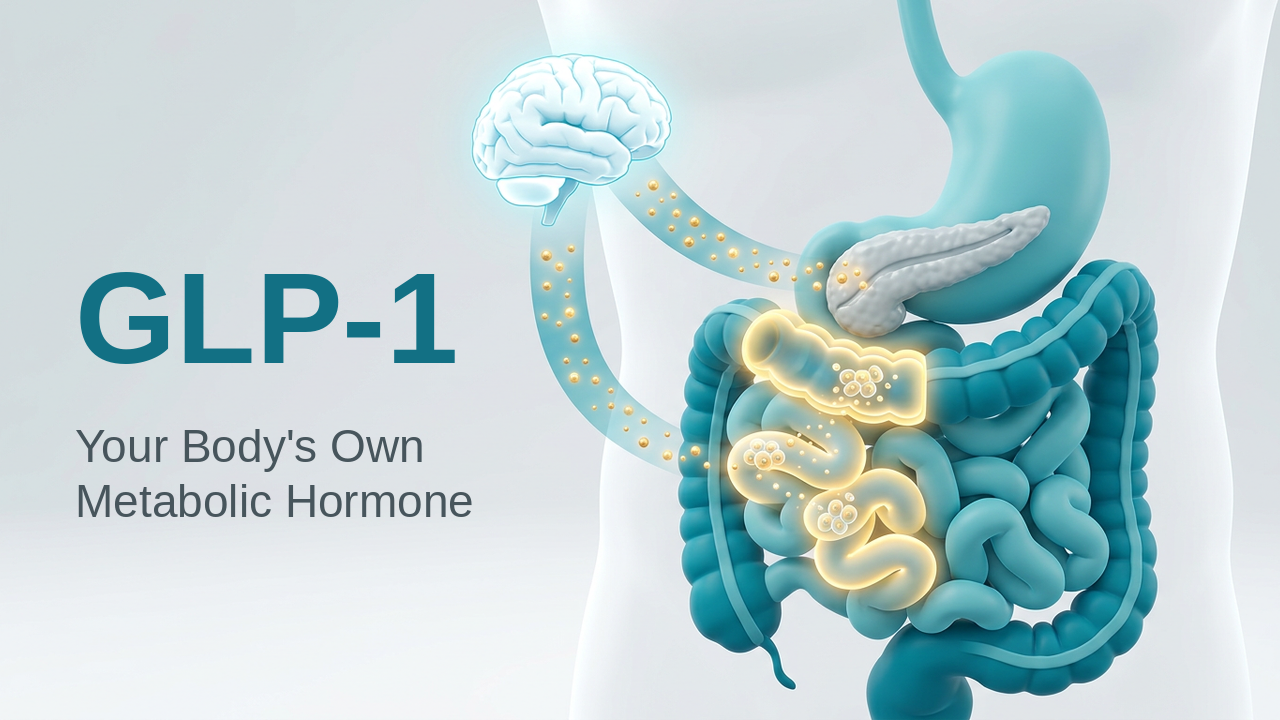
GLP-1 is an incretin hormone, meaning it is released by the gut in response to a meal and, in turn, tells the pancreas to release insulin in proportion to how much glucose is actually present. It is produced mainly by L-cells concentrated in the distal small intestine and colon, and once released it does three things: it potentiates glucose-dependent insulin secretion, it slows gastric emptying so nutrients enter the bloodstream more gradually, and it signals satiety centers in the brain (Kabahizi et al., 2021, British Journal of Pharmacology).
GLP-1 receptor agonist medications were engineered specifically to exploit this pathway. Rather than relying on the small, short-lived amount of GLP-1 your gut releases after a meal (native GLP-1 has a half-life under two minutes before enzymes break it down), these drugs are modified to resist that breakdown and stay active in circulation for hours to a week at a time, at levels well above what the body produces on its own (Tschöp et al., 2023, Diabetologia). That is a real and clinically powerful mechanism. It is also a different thing, in scale, from anything a meal or a workout can do — which is the most important context for everything below.
The Honest Comparison: Natural vs. Pharmaceutical GLP-1
This is worth stating plainly and up front, because it is the part that separates a legitimate discussion of this hormone from the wave of "natural GLP-1" marketing that has become common: lifestyle-driven increases in GLP-1 are real, but modest, and they are not in the same range as medication.
A 2017 study in Diabetes (Bueno et al.) set out specifically to find non-injectable ways to raise endogenous GLP-1. Individually, oral compounds targeting GLP-1-release pathways only modestly increased circulating GLP-1 — roughly 5 to 30 picomoles per liter (pmol/L). Injectable GLP-1 medications, by comparison, sustain levels around 50 pmol/L, and the researchers could only approach drug-like elevations (300–400 pmol/L) by simultaneously combining several distinct pharmacological mechanisms at once — not through diet or behavior. A more recent 2026 review in Advances in Nutrition (Wang et al.) comparing dietary fiber to GLP-1 receptor agonists is direct about this: weight loss from fiber alone is "typically more modest" than from the medications, even though both work partly through the same gut-hormone pathway.
None of this means the natural pathway is meaningless — the research below shows it is real and worth using. It means the honest framing is "supporting your body's own GLP-1 response," not "a free alternative to Ozempic." If you are on a GLP-1 medication or considering one, nothing here is a reason to change that plan without your doctor.
Lever 1: The Order You Eat Your Food
The most-studied natural lever is simple: eating protein and vegetables first, fiber and healthy fats second, and carbohydrates last, within the same meal. A 2018 study in Diabetes, Obesity & Metabolism (Shukla et al.) found this sequence alone blunted post-meal glucose spikes by more than 40% compared to eating carbohydrates first, in people with prediabetes. The 2020 PATTERN study (Sun et al., Clinical Nutrition) found the same vegetable-then-meat-then-rice order both flattened the glucose response and increased natural GLP-1 release compared to other sequences. A 2020 review in Nutrients (Kubota et al.) explains the likely mechanism: protein and fat encountered before carbohydrate promote GLP-1 secretion, delay gastric emptying, and suppress appetite through vagus-nerve signaling. Two more recent trials — a 2024 Diabetes Care study (Touhamy et al.) and a 2023 randomized trial in Nutrients (Shukla et al.) — found the carbohydrate-last pattern also improved glycemic variability and produced modestly greater weight loss than standard counseling over 16 weeks.
One honest limit, worth stating directly: every one of these studies tested plated meals with separable components — a plate with distinct protein, vegetables, and starch you can choose the order of. None tested a mixed or composite dish. If your meal is already combined — a stew, a casserole, a stir-fry, a sandwich — there is no sequence left to control. For meals like that, what matters is what went into the dish to begin with: more protein and vegetables relative to refined starch, not the order you take bites.
Lever 2: Protein, Especially Earlier in the Day
Protein is one of the most consistent nutrient triggers for GLP-1 release. A 2021 narrative review in Advances in Nutrition (Watkins et al.) found that protein combined with calcium activates receptors on L-cells with particular potency. A controlled crossover study (van der Klaauw et al., 2013, Obesity) found a high-protein breakfast raised GLP-1 more, and for longer, than a high-fat or high-carbohydrate breakfast matched for calories. A separate study in 72 men (Bowen et al., 2006, Journal of Clinical Endocrinology & Metabolism) found whey, soy, and gluten protein all elevated GLP-1 and prolonged fullness compared to an equivalent amount of glucose, regardless of body weight. Looking closer at mechanism, a 2020 study in Nutrients (Rigamonti et al.) identified eight specific amino acids in whey protein — including leucine, isoleucine, and lysine — that correlated directly with higher GLP-1 and reduced hunger.
The practical takeaway is straightforward: most people front-load carbohydrates and skip protein at breakfast, which is exactly backwards from what this research supports. Leading with a real protein source at the first meal of the day is a low-effort way to engage this pathway.
Lever 3: Fermentable Fiber and Your Gut Bacteria
Fiber's effect on GLP-1 runs through your gut bacteria, not through fiber itself. A landmark 2012 study in Diabetes (Tolhurst et al.) established that when gut bacteria ferment fiber into short-chain fatty acids — acetate, propionate, and butyrate — those short-chain fatty acids bind directly to receptors (FFAR2 and FFAR3) on L-cells and trigger GLP-1 release. A 2016 review in Nutrition & Metabolism (Bodnaruc et al.) confirmed this applies to whole foods people actually eat: high-fiber grains, nuts, avocados, and eggs. Human data backs this up directly — a 2024 study in Science Translational Medicine (Dagbasi et al.) fed volunteers high- versus low-fiber diets and sampled their intestinal fluid directly through a nasoenteric tube, finding the high-fiber diet increased the related satiety hormone PYY for four hours after eating. Older animal research (Reimer & McBurney, 1996, Endocrinology) showed the same fiber-to-GLP-1 pathway at the level of gene expression in the gut lining.
Practically, this points to fermentable fiber sources specifically — foods like oats, barley, legumes, and a wide variety of vegetables — rather than fiber in general, since it is the bacterial fermentation step that produces the active signal.
Lever 4: Consistent Movement Over Months, Not a Single Workout
Exercise raises GLP-1 too, but the timeline matters more here than with the other three levers. A meta-analysis of acute exercise studies (Schubert et al., 2014, Sports Medicine) found a single bout of exercise raises GLP-1 only modestly — a median increase of about 13%. The more meaningful finding comes from a 2025 randomized trial in Obesity (Holt et al.): after a full year of structured moderate-to-vigorous exercise following weight loss, participants' post-meal GLP-1 response increased by 37% compared to their own baseline, and by 25% more than a usual-activity control group. Notably, in that same trial, the group taking the GLP-1 medication liraglutide showed no additional increase in this specific measure — a reminder that the medication and natural pathways don't necessarily move the same lever the same way. The underlying mechanism appears to involve interleukin-6, a signaling molecule released by working muscle that in turn stimulates L-cells (Ellingsgaard et al., 2011, Nature Medicine).
The takeaway: don't expect a single workout to meaningfully move this number. The real effect shows up after months of consistent activity, which is a different pitch than most "exercise for GLP-1" content makes.
If You're Already on a GLP-1 Medication
Everything above works with your medication's own mechanism, not against it — you are supporting the same pathway the drug amplifies, not competing with it. None of these strategies are a reason to reduce, pause, or stop a prescribed GLP-1 medication on your own. If you want to combine these habits with your treatment, or you're wondering whether your protein and fiber intake is undermining or supporting what your medication is doing, that's a specific, answerable question worth bringing to your prescribing doctor at your next appointment.
Key Takeaways
- GLP-1 is your own hormone first. Medications mimic and amplify a pathway your gut already runs every time you eat.
- The scale is genuinely different. Lifestyle levers raise endogenous GLP-1 modestly; pharmaceutical agonists sustain levels far beyond what diet or exercise can reach. Treat any claim that frames food as a free substitute for medication with real skepticism — including this one, if it ever drifts that direction.
- Meal order works, with a real limit. Protein and vegetables first, carbs last, blunts glucose spikes by over 40% in the research — but only for plated meals with separable components, not mixed dishes.
- Protein earlier in the day is an easy lever. Most people do the opposite of what the research supports at breakfast.
- Fiber works through your gut bacteria, not fiber alone. Fermentable fiber sources produce the short-chain fatty acids that actually trigger the response.
- Exercise's effect builds over months. A single workout barely moves GLP-1; a year of consistency produced a real, measured increase.
References
- Bodnaruc AM, et al. Nutritional modulation of endogenous glucagon-like peptide-1 secretion: a review. Nutrition & Metabolism. 2016;13:92.
- Bowen J, et al. Appetite regulatory hormone responses to various dietary proteins differ by body mass index status despite similar reductions in ad libitum energy intake. Journal of Clinical Endocrinology and Metabolism. 2006;91(8):2913–2919.
- Bueno AB, et al. Mechanisms to Elevate Endogenous GLP-1 Beyond Injectable GLP-1 Analogs and Metabolic Surgery. Diabetes. 2017;66(2):323–331.
- Dagbasi A, et al. Diet shapes the metabolite profile in the intact human ileum, which affects PYY release. Science Translational Medicine. 2024.
- Ellingsgaard H, et al. Interleukin-6 enhances insulin secretion by increasing glucagon-like peptide-1 secretion from L cells and alpha cells. Nature Medicine. 2011;17(11):1481–1489.
- Holt J, et al. One Year of Exercise After Weight Loss Increases Postprandial GLP-1 Secretion in Contrast to Usual Activity or GLP-1 Receptor Agonist Treatment. Obesity. 2025.
- Kabahizi A, et al. Glucagon-like peptide-1 (GLP-1) signalling in the brain: From neural circuits and metabolism to therapeutics. British Journal of Pharmacology. 2021.
- Kubota S, et al. Meal Sequence and Glucose Excursion, Gastric Emptying, and Incretin Secretion. Nutrients. 2020.
- Reimer RA, McBurney MI. Dietary fiber modulates intestinal proglucagon messenger ribonucleic acid and postprandial secretion of glucagon-like peptide-1 and insulin in rats. Endocrinology. 1996;137(9):3948–3956.
- Rigamonti AE, et al. The Appetite-Suppressant and GLP-1-Stimulating Effects of Whey Proteins in Obese Subjects are Associated with Increased Circulating Levels of Specific Amino Acids. Nutrients. 2020;12(3):775.
- Schubert MM, et al. Acute Exercise and Hormones Related to Appetite Regulation: A Meta-Analysis. Sports Medicine. 2014;44(3):387–403.
- Shukla AP, et al. Food order has a significant impact on postprandial glucose and insulin levels. Diabetes, Obesity & Metabolism. 2018.
- Shukla AP, et al. Carbohydrate-last meal-pattern intervention. Nutrients. 2023.
- Sun L, et al. Effect of food order on postprandial glucose and GLP-1 (PATTERN study). Clinical Nutrition. 2020.
- Tolhurst G, et al. Short-Chain Fatty Acids Stimulate Glucagon-Like Peptide-1 Secretion via the G-Protein–Coupled Receptor FFAR2. Diabetes. 2012;61(2):364–371.
- Touhamy M, et al. Carbohydrate-last eating order and glycemic variability. Diabetes Care. 2024.
- Tschöp M, et al. Gut hormone-based pharmacology: novel formulations and future possibilities for metabolic disease therapy. Diabetologia. 2023.
- van der Klaauw AA, et al. High Protein Intake Stimulates Postprandial GLP1 and PYY Release. Obesity. 2013;21(8):1602–1607.
- Wang YX, et al. Dietary Fiber and Glucagon-Like Peptide-1 Receptor Agonists in Obesity Management: Converging Mechanisms, Interactions, and Strategies for Durable Weight Control. Advances in Nutrition. 2026.
- Watkins JD, et al. Protein- and Calcium-Mediated GLP-1 Secretion: A Narrative Review. Advances in Nutrition. 2021;12(3).
Metabolic Aide builds meal-timing and sequencing guidance into every personalized protocol, based on your own labs, conditions, and schedule. Get your free protocol.
Written by Metabolic Aide Team
Published on September 24, 2026