Breathwork and the Vagus Nerve: How 4-7-8 Breathing Resets Your Nervous System
Slow breathing at 4-6 breaths per minute activates the vagus nerve and measurably reduces cortisol, blood pressure, and inflammation. Learn the physiology and how to do it correctly.
Summary
The vagus nerve is the primary conduit of the parasympathetic nervous system, regulating heart rate, digestion, inflammation, and stress response. Slow, controlled breathing — particularly techniques that extend the exhale relative to the inhale — directly stimulates vagal afferent fibers, measurably reducing heart rate, cortisol, blood pressure, and systemic inflammation within minutes. A 2018 systematic review in Frontiers in Human Neuroscience (Zaccaro et al.) analyzing 15 controlled studies found that slow-paced breathing (4–6 breaths per minute) reliably increased heart rate variability (HRV), reduced sympathetic tone, and improved subjective and objective markers of stress. The 4-7-8 breathing technique, developed by Dr. Andrew Weil based on ancient pranayama practice, applies these principles in a structured format shown in clinical settings to reduce cortisol, lower blood pressure, and improve sleep onset. This article explains the science of vagal breathing and provides a complete implementation protocol.
The Autonomic Nervous System: Two Modes
The autonomic nervous system governs the body's involuntary functions — heart rate, blood pressure, digestion, immune activity, and the stress response. It operates in two fundamental modes:
The Sympathetic Nervous System (SNS): The "fight-or-flight" system. When activated, it increases heart rate, elevates blood pressure, diverts blood to muscles, suppresses digestion, and releases cortisol and adrenaline. Vital for acute stress response, but chronically overactivated in modern humans.
The Parasympathetic Nervous System (PNS): The "rest-and-digest" system. When dominant, it slows heart rate, lowers blood pressure, restores digestion, reduces cortisol, and activates immune surveillance and tissue repair. The vagus nerve is its primary nerve trunk.
The vagus nerve (cranial nerve X) is the longest nerve in the body, running from the brainstem through the neck, chest, and abdomen. It carries bidirectional signals — approximately 80% of vagal fibers are afferent (sending signals from the body to the brain) and 20% are efferent (sending signals from the brain to the organs). This means that most vagal communication is the body reporting to the brain, not the brain commanding the body.
This architecture is why breathing is such a powerful intervention: by voluntarily controlling the breath, you directly modulate afferent vagal signaling, which then changes brain activity, HRV, cortisol, and inflammatory tone.
The Physiology of Slow Breathing
Respiratory Sinus Arrhythmia and HRV
Heart rate is not constant — it speeds up slightly during inhalation and slows during exhalation. This normal variation, called respiratory sinus arrhythmia (RSA), is mediated by the vagus nerve. During inhalation, the lungs stretch, stimulating pulmonary stretch receptors that temporarily reduce vagal outflow, allowing heart rate to increase. During exhalation, this inhibition releases and heart rate slows.
Heart rate variability (HRV) — the beat-to-beat variation in heart rate — is the most reliable measurable indicator of vagal tone and parasympathetic dominance. Higher HRV is consistently associated with:
- Better cardiovascular health (Thayer et al., 2010, Neuroscience & Biobehavioral Reviews)
- Lower all-cause mortality (Kleiger et al., 1987, American Journal of Cardiology)
- Improved emotional regulation and stress resilience
- Lower systemic inflammation (measured by CRP and IL-6)
Slow breathing at 4–6 breaths per minute (compared to the typical 12–20 breaths/minute) maximizes RSA amplitude. At approximately 5–6 breaths per minute, the breathing rhythm becomes synchronized with the natural oscillation frequency of the baroreceptor reflex, creating resonance frequency breathing — a state of maximal HRV amplification.
A landmark study in Circulation (Bernardi et al., 2001) demonstrated that breathing at approximately 6 breaths/minute significantly increased HRV, reduced blood pressure, and improved arterial oxygen saturation compared to normal breathing and 15 breaths/minute — effects that were immediate and sustained during the breathing session.
Baroreceptor Activation
The aorta and carotid arteries contain baroreceptors — pressure sensors that detect changes in blood pressure and communicate with the brainstem via the vagus nerve and glossopharyngeal nerve. Slow, deep diaphragmatic breathing creates greater pressure excursions with each breath, maximally stimulating these baroreceptors.
Baroreceptor stimulation activates the nucleus tractus solitarius (NTS) in the brainstem, which then increases parasympathetic outflow via the nucleus ambiguus — reducing heart rate, lowering blood pressure, and suppressing sympathetic activity systemically.
Diaphragmatic Pressure and Abdominal Vagal Stimulation
The vagus nerve innervates the digestive organs, liver, spleen, and kidneys. Diaphragmatic breathing creates rhythmic pressure changes in the abdominal cavity that mechanically stimulate vagal afferents in these organs. This visceral vagal signaling contributes to the calming, digestion-restoring effects of deep abdominal breathing.
Cortisol Reduction: The Evidence
The reduction in cortisol from slow breathing interventions is well-documented:
- A 2017 randomized controlled trial in the Journal of Neurological Sciences (Ma et al.) found that 20 minutes of slow breathing at 6 breaths/minute significantly reduced salivary cortisol levels compared to controls, with effects lasting several hours post-session.
- A meta-analysis in Biological Psychology (Zaccaro et al., 2018) found that breath-controlled techniques consistently reduced cortisol across studies, with effect sizes increasing with practice duration and lower breathing rates.
- Research on pranayama (yogic breathing) from the International Journal of Yoga found that 8 weeks of daily slow breathing practice reduced morning cortisol by 14% and improved the cortisol awakening response.
The mechanism involves the HPA axis: increased vagal activity reduces hypothalamic CRH release, which in turn reduces ACTH secretion from the pituitary, which reduces adrenal cortisol output. The vagus nerve also directly modulates adrenal sensitivity to ACTH signaling.
The Vagal Anti-Inflammatory Reflex
One of the most clinically significant discoveries about the vagus nerve is the cholinergic anti-inflammatory pathway, described by Kevin Tracey in Nature (2002). When vagal afferents detect inflammatory cytokines (IL-1β, TNF-α, IL-6) in the periphery, they relay this information to the brainstem. The brainstem responds by increasing efferent vagal signaling to the spleen and other immune organs, where acetylcholine (the vagal neurotransmitter) directly suppresses macrophage production of these cytokines.
This reflex is so significant that vagus nerve stimulation devices have been developed and approved for the treatment of rheumatoid arthritis (DARPA-funded bioelectronics medicine research). The non-invasive approach — slow breathing to activate the vagus — produces a similar, though less intense, anti-inflammatory response.
A study in Proceedings of the National Academy of Sciences (Lehrer et al., 2010) demonstrated that biofeedback-guided slow breathing (resonance frequency) significantly reduced serum C-reactive protein (CRP) — the primary marker of systemic inflammation — in adults with established cardiovascular risk.
The 4-7-8 Breathing Technique
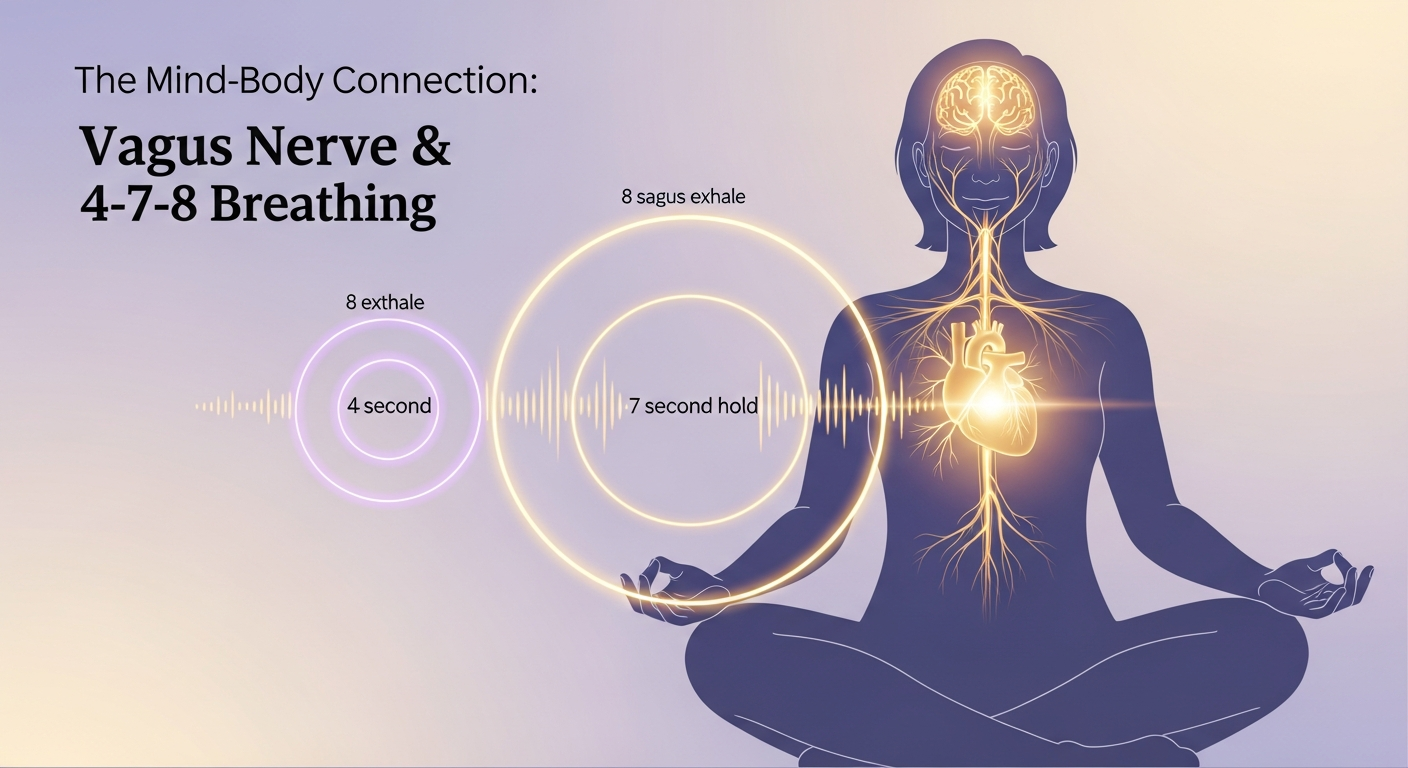
The 4-7-8 technique was systematized by Dr. Andrew Weil, integrating the pranayama technique Kumbhaka (breath retention) with a Western clinical framework. Its structure is designed to:
- Slow the breathing rate below 4 breaths/minute (even slower than resonance frequency)
- Extend the exhale to twice the inhale duration (maximizing RSA and parasympathetic activation)
- Use breath retention to increase blood CO2, enhancing the Bohr effect and promoting relaxation
Protocol
Position: Sit upright or lie flat. Place the tip of your tongue against the ridge of tissue behind your upper front teeth and keep it there throughout.
The cycle (repeat 4–8 times):
- Inhale through the nose for 4 counts — breathe slowly and deeply into the abdomen, not the chest
- Hold for 7 counts — gentle hold, not straining; this builds CO2 and allows deep oxygen-hemoglobin saturation
- Exhale completely through the mouth for 8 counts — make a whoosh sound as the air escapes; fully empty the lungs
Ratio is key, not absolute timing: The 4:7:8 ratio can be slowed (e.g., 6:10:12) for deeper effect. The critical element is the extended exhale relative to inhale.
Frequency: 4–8 cycles twice daily. Morning: after waking, before coffee (reduces cortisol spike amplitude and promotes calm alertness). Evening: 30–60 minutes before bed (reduces cortisol and promotes sleep onset).
Why the Extended Exhale Works
The exhale phase is when parasympathetic dominance is greatest. Extending the exhale:
- Prolongs the phase of RSA-mediated heart rate deceleration
- Maximizes baroreceptor stimulation from the pressure drop
- Increases CO2, which directly dilates cerebral blood vessels and promotes calm
- Activates the anterior cingulate cortex (ACC), which regulates emotional response and fear processing
Research from Stanford (Balban et al., 2023, Cell Reports Medicine) demonstrated that a cyclic sighing technique (extended exhale) was superior to mindfulness meditation and box breathing for real-time mood improvement and physiological calming — as measured by HRV, respiratory rate, and subjective affect.
Box Breathing (Alternative Protocol)
Box breathing (used by U.S. Navy SEALs for stress regulation in combat) uses equal phases:
- Inhale through the nose for 4 counts
- Hold for 4 counts
- Exhale through the mouth for 4 counts
- Hold for 4 counts
This produces equivalent breathing rates to 4-7-8 without the extended exhale bias. It is particularly effective for acute stress management — before a difficult conversation, medical procedure, or performance event — where symmetry and focus are prioritized over maximum relaxation depth.
Building Vagal Tone: The Long-Term Picture
Single breathing sessions produce acute vagal activation. But regular practice — like any physiological training — produces structural adaptations:
- Increased resting HRV: Studies show that 8 weeks of daily slow breathing practice (20 minutes/day) significantly increases resting HRV — indicating improved baseline vagal tone (Lehrer & Gevirtz, 2014, Frontiers in Psychology).
- Reduced baseline cortisol: Chronic practitioners of pranayama show lower morning cortisol and a more appropriately timed cortisol awakening response.
- Improved emotional resilience: Higher vagal tone is associated with greater capacity to recover from negative emotional stimuli — a direct measure of HPA axis regulation.
- Reduced visceral fat: The cortisol-reduction pathway described above translates to reduced visceral fat accumulation in chronic practitioners (via the cortisol-glucocorticoid receptor mechanism described in separate research on stress and adiposity).
Combining Breathwork with the Morning Protocol
The evidence supports a specific sequence for morning breathwork integration:
- Wake at consistent time → triggers appropriate CAR
- Morning outdoor walk (nasal breathing) → NO production, shear stress, circadian anchoring
- 4-7-8 breathing (5 cycles) → dampens exaggerated morning cortisol spike, promotes calm focus
- Coffee/caffeine → adenosine blockade with sympathetic system already calm
In the evening:
- 4-7-8 breathing (8 cycles) → initiates cortisol decline, increases HRV, prepares for sleep
- No screens after breathwork → melatonin production uninterrupted
- Cool sleep environment → temperature drop consolidates sleep onset
The breathwork sessions function as pharmacological-grade interventions — requiring no equipment, no cost, and producing measurable effects within the session itself.
Key Takeaways
- 80% of vagal fibers are afferent: The vagus nerve mainly reports body state to the brain — making breathwork (a body-level input) a direct way to change brain and hormonal output.
- Slow breathing at 4–6 breaths/minute maximizes HRV and vagal tone: This is the resonance frequency of the baroreceptor reflex and produces the largest measurable parasympathetic activation.
- The extended exhale drives the relaxation response: The exhale phase is when heart rate decelerates and parasympathetic dominance peaks — the 4-7-8 technique maximizes this.
- The vagal anti-inflammatory reflex suppresses cytokines: Vagal activation directly inhibits macrophage production of TNF-α and IL-6 through the cholinergic anti-inflammatory pathway.
- Regular practice builds structural adaptations: 8 weeks of daily slow breathing measurably increases resting HRV — the best non-invasive indicator of cardiovascular and metabolic resilience.
- Morning and evening sessions target different goals: Morning breathwork dampens excess cortisol; evening breathwork promotes sleep onset by initiating cortisol decline.
References
- Balban MY, et al. Brief structured respiration practices enhance mood and reduce physiological arousal. Cell Reports Medicine. 2023;4(1).
- Bernardi L, et al. Effect of rosary prayer and yoga mantras on autonomic cardiovascular rhythms. British Medical Journal. 2001;323(7327):1446–1449.
- Kleiger RE, et al. Decreased heart rate variability and its association with increased mortality after acute myocardial infarction. American Journal of Cardiology. 1987;59(4):256–262.
- Lehrer PM, Gevirtz R. Heart rate variability biofeedback: how and why does it work? Frontiers in Psychology. 2014;5:756.
- Lehrer PM, et al. Heart rate variability biofeedback improves cardiac vagal tone and reduces inflammatory markers. Applied Psychophysiology and Biofeedback. 2010.
- Ma X, et al. The effect of diaphragmatic breathing on attention, negative affect, and stress in healthy adults. Frontiers in Psychology. 2017;8:874.
- Thayer JF, et al. The relationship of autonomic imbalance, heart rate variability and cardiovascular disease risk factors. International Journal of Cardiology. 2010;141(2):122–131.
- Tracey KJ. The inflammatory reflex. Nature. 2002;420(6917):853–859.
- Weil A. Natural Health, Natural Medicine. Boston: Houghton Mifflin, 1995.
- Zaccaro A, et al. How breath-control can change your life: a systematic review on psycho-physiological correlates of slow breathing. Frontiers in Human Neuroscience. 2018;12:353.
Metabolic Aide includes a guided breathwork sequence — morning and evening — tailored to your cortisol profile and HRV baseline. Get your free protocol.
Related Articles
Deep Sleep and Metabolism: How Poor Sleep Drives Insulin Resistance
One week of 5-hour nights causes insulin resistance equal to 20 pounds of weight gain. Learn the science linking deep sleep to metabolic health and evidence-based protocols to fix it.
Cortisol and Visceral Fat: How Stress Hormones Sabotage Your Metabolism
Chronic stress doesn't just feel bad — it physically reshapes your body. Learn how cortisol dysregulation drives visceral fat accumulation and how to reset your stress hormone rhythm.
Written by Metabolic Aide Team
Published on March 10, 2026