Cortisol and Visceral Fat: How Stress Hormones Sabotage Your Metabolism
Chronic stress doesn't just feel bad — it physically reshapes your body. Learn how cortisol dysregulation drives visceral fat accumulation and how to reset your stress hormone rhythm.
Summary
Cortisol is the body's primary stress hormone and a master metabolic regulator. When cortisol follows its natural diurnal rhythm — high in the morning, steadily declining through the day, near-zero at night — it supports energy, immune function, and healthy metabolism. When this rhythm is disrupted by chronic stress, poor sleep, or lifestyle factors, the consequences are profound: visceral fat accumulates, insulin resistance develops, blood pressure rises, and immune function is suppressed. Research in Psychosomatic Medicine (Epel et al., 2000) demonstrated that women with higher cortisol reactivity to stress had significantly more visceral fat than those with lower reactivity — independent of total body fat. This article explains the biology of cortisol, how its disruption drives disease, and what evidence-based interventions actually reset it.
Cortisol: The Master Metabolic Hormone
Cortisol is a glucocorticoid steroid hormone produced by the adrenal cortex in response to signals from the hypothalamic-pituitary-adrenal (HPA) axis. Its biological purpose is to mobilize energy for the body to respond to stress — hence its classification as the "fight-or-flight" hormone.
Under acute stress, cortisol performs critical and appropriate functions:
- Raises blood glucose by stimulating gluconeogenesis in the liver
- Suppresses non-essential processes (digestion, reproduction, immune activity) to redirect energy to muscles
- Enhances cardiovascular output
- Sharpens alertness and focus
The problem arises when this acute response becomes chronic. Modern stressors — work pressure, financial anxiety, relationship conflict, sleep deprivation, excessive exercise, inflammatory diet — activate the HPA axis repeatedly throughout the day without the physical resolution (running, fighting, moving) that would clear the cortisol spike and reset the system.
The Cortisol Awakening Response
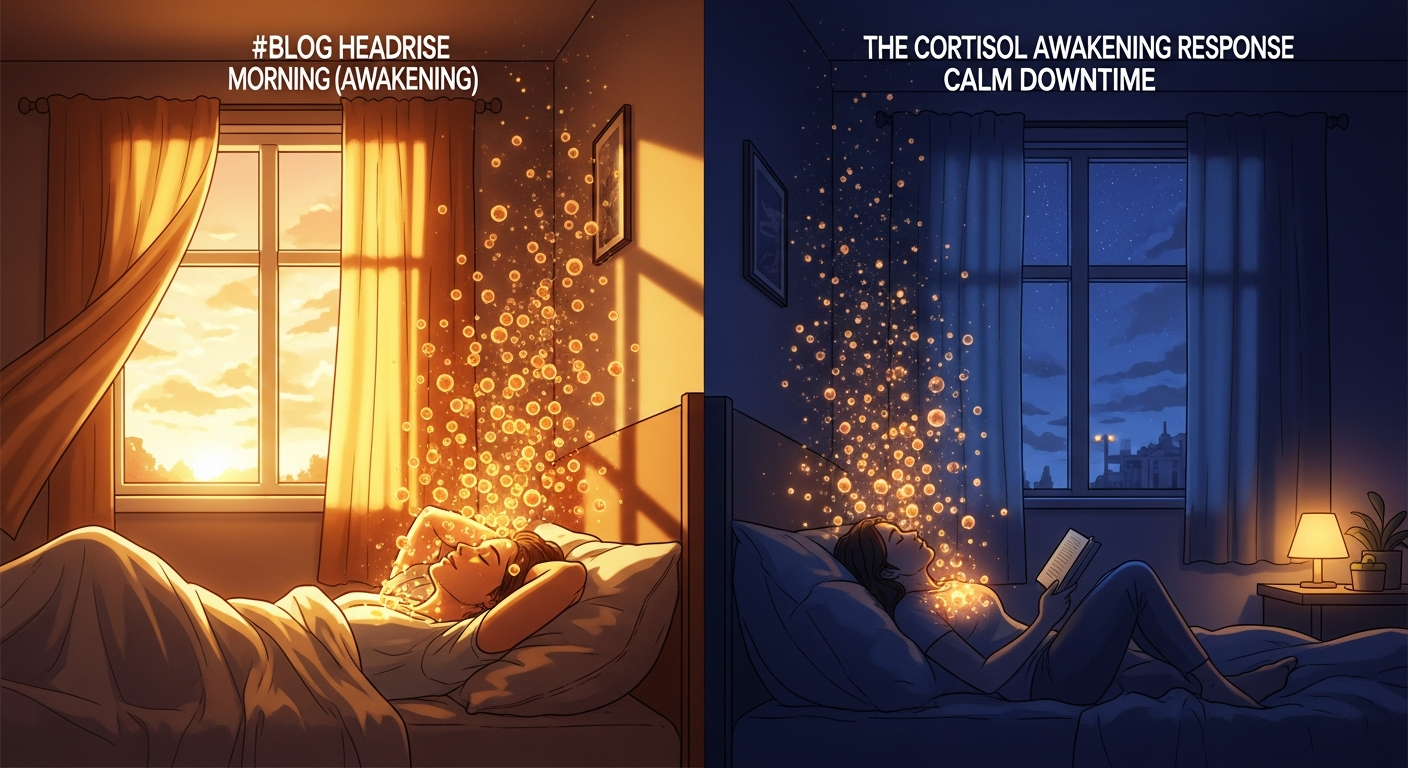
The Cortisol Awakening Response (CAR) is the sharp, 50–100% increase in cortisol that occurs within the first 20–45 minutes of waking. This is not simply a stress response — it is a programmed anticipatory rise that serves as the circadian anchor for the entire day's metabolic and hormonal activity.
A robust CAR signals that the HPA axis is healthy and well-regulated. It prepares the body for the day ahead by:
- Mobilizing glucose for brain function
- Activating immune surveillance
- Regulating inflammatory tone
- Coordinating the timing of all other circadian-dependent processes
A blunted or absent CAR — which occurs with chronic stress, burnout, depression, shift work, and disrupted sleep — is a reliable indicator of HPA dysregulation and is associated with:
- Increased all-cause mortality (Kumari et al., 2011, Psychoneuroendocrinology)
- Higher rates of cardiovascular disease
- Greater susceptibility to infection
- Impaired cognitive function and memory
A 2017 systematic review in Neuroscience & Biobehavioral Reviews (Clow et al.) examining 34 studies concluded that a healthy CAR requires consistent wake time, morning light exposure, and adequate nighttime sleep.
How Chronic High Cortisol Drives Visceral Fat
The Cortisol-Visceral Fat Connection
Visceral fat has a 4-fold higher density of glucocorticoid receptors than subcutaneous fat (Pedersen et al., 2004, Obesity Research). This means cortisol's fat-storage signaling preferentially targets the visceral compartment — the dangerous fat around your organs.
Mechanisms by which chronic cortisol elevation drives visceral fat accumulation:
1. Direct lipid deposition: Cortisol activates lipoprotein lipase in visceral adipocytes — the enzyme that pulls triglycerides from the bloodstream into fat cells — while simultaneously inhibiting hormone-sensitive lipase, the enzyme responsible for releasing fat from storage.
2. Insulin resistance amplification: Cortisol antagonizes insulin signaling at multiple steps, causing compensatory hyperinsulinemia. Elevated insulin in turn promotes fat storage in insulin-sensitive adipose tissue. Visceral fat is most responsive to this insulin-driven lipogenesis.
3. Appetite stimulation: Cortisol increases appetite, particularly for high-calorie, high-fat, and high-sugar foods, through interactions with the ghrelin and opioid reward systems (Dallman et al., 2003, PNAS). This stress-driven eating — sometimes called "comfort eating" — directly deposits fuel into the visceral fat depot.
4. Muscle catabolism: Chronic cortisol elevation promotes muscle protein breakdown (catabolism) to provide amino acids for gluconeogenesis. This loss of lean mass reduces insulin-mediated glucose disposal, further worsening insulin resistance.
A definitive human study (Epel et al., 2000, Psychosomatic Medicine) recruited 59 healthy premenopausal women and measured their cortisol reactivity to standardized laboratory stressors. Women with higher cortisol reactivity had significantly greater waist-to-hip ratio and more visceral fat by DEXA — even though both groups had similar total body fat. The effect of stress-driven cortisol elevation on fat distribution was visceral-specific.
Signs of HPA Axis Dysregulation
Cortisol dysregulation exists on a spectrum. Early signs often precede obvious disease by years:
Early-stage (high cortisol pattern):
- Difficulty falling asleep despite feeling exhausted
- "Second wind" of energy in the late evening (10 PM–midnight)
- Weight gain specifically around the midsection despite not eating more
- Salt and sugar cravings (especially mid-afternoon)
- Elevated blood pressure
- Anxiety, irritability, racing thoughts
- Frequent illness (immune suppression)
Later-stage (low cortisol / burnout pattern):
- Profound morning fatigue, difficulty getting out of bed
- Blunted CAR (feeling no energy or alertness upon waking)
- Crashes in the mid-morning and mid-afternoon
- Hypersensitivity to stress — even minor stressors feel overwhelming
- Low blood pressure and dizziness upon standing
- Persistent inflammation and slower recovery from illness or exercise
Assessing cortisol: A 4-point salivary cortisol test (collected upon waking, 30 minutes after waking, noon, and 8 PM) provides the most clinically useful data about the cortisol rhythm. Standard single-point morning blood cortisol tells you nothing about the rhythm.
Evidence-Based Strategies to Reset the Cortisol Rhythm
1. Morning Sunlight (15–20 Minutes)
Light is the most powerful regulator of the HPA axis. Bright light (ideally sunlight, minimum 1,000–10,000 lux) through the retina to the suprachiasmatic nucleus directly stimulates the appropriate morning cortisol rise and suppresses nighttime cortisol production.
A randomized controlled trial in Neuropsychiatric Disease and Treatment (Wirz-Justice et al.) demonstrated that morning bright light therapy normalized the cortisol rhythm in adults with circadian disruption, reducing evening cortisol and improving sleep quality within 1–2 weeks.
2. Consistent Wake Time (the Most Important Sleep Variable)
The timing of waking anchors the entire 24-hour cortisol rhythm. Varying wake time by more than 30–45 minutes (including weekends) progressively desynchronizes the circadian clock, blunting the CAR and dysregulating the evening cortisol decline.
Research from the Harvard Division of Sleep Medicine consistently identifies irregular sleep timing as a major driver of cortisol dysregulation, metabolic syndrome, and mood disorders — independent of total sleep duration.
3. The 4-7-8 Breathing Technique
Slow, controlled breathing at 4–6 breaths per minute activates the parasympathetic nervous system through baroreceptor stimulation and vagal afferent signaling. A 2017 randomized study in the Journal of Neurological Sciences (Ma et al.) found that 20 minutes of slow breathing significantly reduced salivary cortisol levels compared to controls, with effects lasting several hours.
The 4-7-8 technique (inhale through nose for 4 counts, hold for 7 counts, exhale completely for 8 counts) is particularly effective because the extended hold and exhale maximally activate the parasympathetic system. Perform 5–10 cycles in the evening.
4. Aerobic Exercise in the Morning
Moderate aerobic exercise in the morning (walking, cycling, jogging) at 60–70% maximum heart rate stimulates a healthy, appropriate cortisol spike that complements the CAR and drives the subsequent evening decline. This is a fundamentally different cortisol response from chronic psychological stress — it is acute, contextualized, and followed by a rapid recovery.
Critically, high-intensity exercise late in the afternoon or evening significantly elevates cortisol and delays melatonin onset. A study in the European Journal of Applied Physiology (Rosa et al., 2019) found that high-intensity exercise at 6 PM delayed melatonin onset by an average of 45 minutes compared to morning exercise.
5. Ashwagandha (Withania somnifera)
Ashwagandha is the most extensively studied botanical adaptogen for HPA axis regulation. A double-blind, randomized, placebo-controlled trial in Medicine (Chandrasekhar et al., 2012) supplemented adults with 300 mg twice daily of ashwagandha root extract. After 60 days, the ashwagandha group showed:
- 27.9% reduction in serum cortisol
- Significant reductions in stress and anxiety scores (PSS)
- Improved sleep quality
- Reduced food cravings
A 2019 RCT in Medicine (Langade et al.) specifically testing ashwagandha (600 mg/day) for sleep quality found significant improvements in sleep onset latency, total sleep time, and morning alertness over 8 weeks.
6. Phosphatidylserine
Phosphatidylserine (PS) is a phospholipid concentrated in neuronal cell membranes with a well-documented ability to blunt excessive HPA axis activation. A 2014 meta-analysis in Nutrition Reviews (Jäger et al.) found that 400–800 mg/day of PS significantly reduced ACTH (the adrenal stimulating hormone) and cortisol responses to physical and psychological stress.
7. Reducing Caffeine After Noon
Caffeine elevates cortisol by blocking adenosine receptors and stimulating catecholamine release. Afternoon caffeine consumption artificially prolongs the period of elevated cortisol into the evening, when it should be declining. A 2005 study in Psychosomatic Medicine (Lovallo et al.) demonstrated that caffeine amplified the cortisol stress response and that this effect was strongest in the afternoon and evening.
The Cortisol-Sleep-Visceral Fat Vicious Cycle
These systems do not operate independently. Cortisol dysregulation impairs sleep → poor sleep further elevates cortisol → elevated cortisol drives visceral fat accumulation → visceral fat increases systemic inflammation → inflammation dysregulates the HPA axis → worsening cortisol rhythm.
Breaking this cycle requires attacking multiple points simultaneously. The morning routine is the highest-leverage intervention: consistent wake time + morning sunlight + moderate morning movement + appropriate caffeine timing addresses the cortisol rhythm, the sleep-wake cycle, and the inflammatory cascade in one sequence.
Key Takeaways
- Visceral fat has 4x more cortisol receptors than subcutaneous fat: Chronic stress drives fat storage specifically into the most dangerous anatomical location — around your organs.
- The CAR is the linchpin of the cortisol rhythm: A robust morning cortisol spike requires consistent wake time, morning light, and adequate sleep. Without it, the entire day's metabolic regulation is compromised.
- Chronic cortisol elevation causes insulin resistance through multiple mechanisms: Direct insulin antagonism, compensatory hyperinsulinemia, muscle catabolism, and appetite dysregulation all contribute.
- Morning sunlight and consistent wake time are the most powerful circadian anchors: These two behaviors have more impact on cortisol rhythm than any supplement.
- Ashwagandha and phosphatidylserine have clinical trial support: Both significantly reduce cortisol in well-designed randomized controlled trials.
- The cortisol-sleep-visceral fat cycle is self-reinforcing: Breaking it requires addressing wake time, light exposure, exercise timing, and breathwork simultaneously.
References
- Chandrasekhar K, et al. A prospective, randomized double-blind, placebo-controlled study of safety and efficacy of a high-concentration full-spectrum extract of ashwagandha root. Medicine. 2012.
- Clow A, et al. The cortisol awakening response: more than a measure of HPA axis function. Neuroscience & Biobehavioral Reviews. 2010;35(1):97–103.
- Dallman MF, et al. Chronic stress and obesity: a new view of "comfort food." PNAS. 2003;100(20):11696–11701.
- Epel ES, et al. Stress and body shape: stress-induced cortisol secretion is consistently greater among women with central fat. Psychosomatic Medicine. 2000;62:623–632.
- Jäger R, et al. Phospholipids and sports performance. Journal of the International Society of Sports Nutrition. 2007.
- Kumari M, et al. Association between cortisol secretion and subsequent incidence of hypertension. Psychoneuroendocrinology. 2011.
- Langade D, et al. Efficacy and safety of ashwagandha root extract in insomnia and anxiety. Medicine. 2019.
- Lovallo WR, et al. Caffeine stimulation of cortisol secretion across the waking hours in relation to caffeine intake levels. Psychosomatic Medicine. 2005.
- Pedersen SB, et al. Estrogen controls lipolysis by up-regulating alpha2A-adrenergic receptors. Obesity Research. 2004.
Metabolic Aide generates a morning protocol designed to anchor your cortisol rhythm — including wake time, light exposure, movement, and breathwork sequences tailored to your profile. Get your free protocol.
Related Articles
Visceral Fat: Why Your Waist Measurement Beats the Scale
Your weight doesn't predict disease risk — your waist-to-height ratio does. Learn the science of visceral fat, why it's dangerous, and how to measure what actually matters.
Deep Sleep and Metabolism: How Poor Sleep Drives Insulin Resistance
One week of 5-hour nights causes insulin resistance equal to 20 pounds of weight gain. Learn the science linking deep sleep to metabolic health and evidence-based protocols to fix it.
Evidence-Based Supplements for Metabolic Health: What the Research Actually Shows
Most supplements have weak evidence. Psyllium husk, beet juice, magnesium, and Ceylon cinnamon have rigorous clinical trial data. Learn what works, what doesn't, and why.
Written by Metabolic Aide Team
Published on February 20, 2026