Visceral Fat: Why Your Waist Measurement Beats the Scale
Your weight doesn't predict disease risk — your waist-to-height ratio does. Learn the science of visceral fat, why it's dangerous, and how to measure what actually matters.
Summary
Visceral fat — the fat stored deep inside your abdominal cavity around your organs — is fundamentally different from subcutaneous fat and is one of the most powerful drivers of metabolic disease. Research consistently shows that your waist-to-height ratio (WHtR) is a better predictor of cardiovascular risk, type 2 diabetes, and all-cause mortality than BMI or body weight alone. A WHtR above 0.5 signals dangerous visceral fat accumulation regardless of what the scale says. This article explains the biology, the measurements, and the evidence-based strategies to target visceral fat specifically.
Why the Scale Is the Wrong Tool
Body weight is a blunt instrument. Two people can weigh exactly the same, have the same BMI, and have dramatically different disease risk — because where fat is stored matters as much as how much fat you carry.
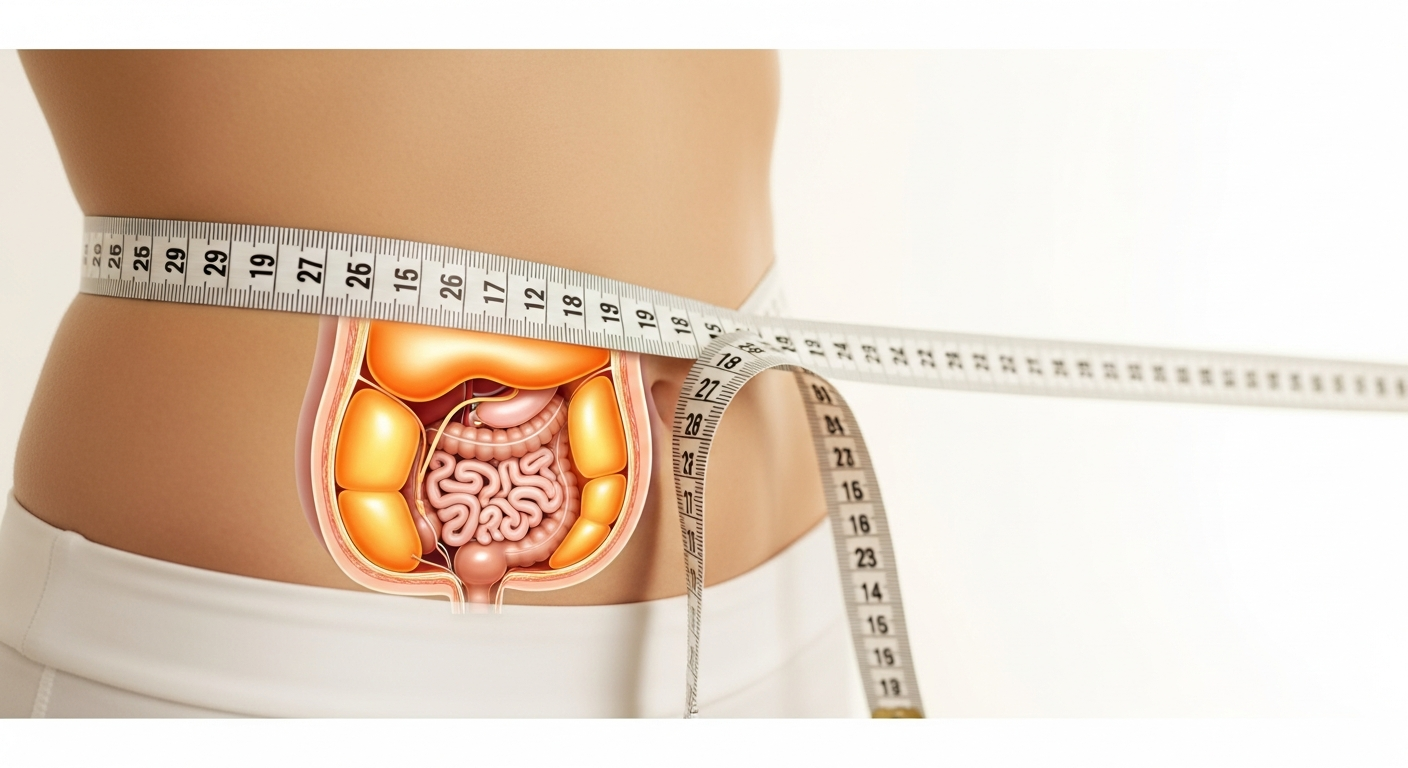
Subcutaneous fat sits just beneath your skin. You can pinch it. It's relatively benign metabolically. Visceral fat is different: it sits inside your abdominal cavity, packed between and around your organs — your liver, intestines, pancreas, and heart. This fat is metabolically active in a way that subcutaneous fat is not.
A landmark 2000 study published in the International Journal of Obesity by Savva et al. demonstrated that waist-to-height ratio outperformed BMI as a predictor of cardiovascular risk factors including hypertension, dyslipidemia, and insulin resistance across multiple ethnic groups. A 2012 meta-analysis in PLoS ONE by Ashwell, Gunn, and Gibson, reviewing 78 studies covering over 300,000 participants, concluded that WHtR had superior predictive value over BMI for cardiometabolic risk.
The simple rule that emerged from this research: keep your waist circumference to less than half your height. If your height is 68 inches (5 feet 8 inches), your waist should be under 34 inches.
What Makes Visceral Fat Dangerous
It Behaves Like a Hormone Factory
Visceral fat is not passive storage. It is endocrine tissue — it actively produces and secretes hormones and inflammatory proteins called adipokines and cytokines that enter your bloodstream and affect nearly every organ system.
Key inflammatory signals secreted by visceral fat include:
- Interleukin-6 (IL-6): Promotes systemic inflammation and is associated with insulin resistance. Visceral fat contributes approximately 25–35% of total circulating IL-6 in the body (Mohamed-Ali et al., 1997, Journal of Clinical Endocrinology & Metabolism).
- Tumor Necrosis Factor-alpha (TNF-α): Directly impairs insulin receptor signaling, driving insulin resistance at the cellular level (Hotamisligil et al., 1993, Science).
- Resistin: Promotes insulin resistance and atherogenesis.
- Plasminogen Activator Inhibitor-1 (PAI-1): Increases blood clotting risk and is elevated in people with high visceral fat.
- Reduced Adiponectin: As visceral fat increases, adiponectin — an anti-inflammatory, insulin-sensitizing hormone — decreases. Low adiponectin is independently associated with type 2 diabetes and cardiovascular disease.
The Portal Vein Problem
Visceral fat has a unique anatomical advantage over other fat depots: it drains directly into the portal vein, which feeds straight into the liver. This means the liver is the first organ exposed to the inflammatory cytokines and free fatty acids released by visceral fat. This portal delivery contributes to:
- Non-alcoholic fatty liver disease (NAFLD): Now affecting an estimated 25% of the global population (Younossi et al., 2016, Hepatology).
- Hepatic insulin resistance: The liver becomes less responsive to insulin, driving higher circulating glucose and insulin levels.
- Dyslipidemia: Excess free fatty acid delivery to the liver increases VLDL triglyceride production and reduces HDL cholesterol.
The Insulin Resistance Cascade
High visceral fat initiates a cascade: elevated cytokines impair insulin receptor function → pancreatic beta cells compensate by producing more insulin → fasting insulin rises → tissues become progressively more insulin resistant → blood glucose rises → HbA1c climbs. This is the road from metabolic syndrome to type 2 diabetes.
A study in Diabetes Care (Carey et al., 1996) showed that even in people with normal BMI, those with high visceral fat measured by CT scan had significantly higher fasting insulin and worse glucose tolerance than those with low visceral fat.
How to Measure Your Visceral Fat Risk
The Waist-to-Height Ratio
The most practical and validated measurement is WHtR:
WHtR = Waist Circumference ÷ Height
Both measurements must use the same unit (inches or centimeters).
Measurement technique:
- Stand relaxed, feet together
- Measure waist circumference at the level of the navel, not the narrowest point
- Measure after a normal exhale
- Do not suck in
Risk thresholds based on Ashwell & Hsieh (2005), Nutrition Research Reviews:
| WHtR | Risk Category |
|---|---|
| Below 0.40 | Underweight range |
| 0.40–0.49 | Healthy range |
| 0.50–0.59 | Increased risk — action recommended |
| 0.60 and above | High risk — urgent intervention |
The Neck Circumference
Neck circumference is a secondary proxy for visceral fat and upper body fat distribution. It correlates with sleep apnea risk and insulin resistance. For men, a neck circumference above 17 inches (43 cm) and for women above 16 inches (41 cm) is associated with elevated cardiometabolic risk (Ben-Noun & Laor, 2006, Hypertension Research).
The Gold Standard: CT and DEXA
Clinical measurement of visceral fat uses CT imaging (the gold standard) or DEXA scanning. CT cross-sections at the L4-L5 vertebral level allow precise calculation of visceral adipose tissue (VAT) area. A VAT area above 100 cm² in men and 80 cm² in women is associated with significantly elevated metabolic risk (Despres et al., 1990, Arteriosclerosis).
For most people, WHtR provides 90% of the clinical information at zero cost.
Why Losing Weight Is Not the Same as Losing Visceral Fat
This distinction is critical. Standard caloric restriction causes loss of both fat and lean muscle mass. Some diets cause disproportionate subcutaneous fat loss while visceral fat remains stubbornly elevated.
A 2011 study in Obesity by Irving et al. compared aerobic exercise to resistance training in postmenopausal women. Both groups lost similar amounts of weight, but only the aerobic exercise group showed significant reductions in visceral fat measured by CT. This illustrates that the type of intervention determines where fat is lost from.
Strategies with the strongest evidence for specifically reducing visceral fat:
- Intermittent fasting: A 2019 meta-analysis in Obesity Reviews (Harris et al.) found that time-restricted eating significantly reduced visceral fat compared to continuous caloric restriction, even when total calorie intake was similar.
- Aerobic exercise: Specifically, vigorous aerobic exercise (70–80% maximum heart rate) consistently reduces visceral fat independent of weight loss (Ross et al., 2000, Annals of Internal Medicine).
- Low-glycemic eating patterns: Reducing refined carbohydrates and sugar directly reduces visceral fat accumulation by lowering fasting insulin, the primary driver of fat storage in this depot.
- Sleep optimization: Spiegel et al. (2004, Sleep) demonstrated that even partial sleep deprivation increases cortisol in the evening, which directly drives visceral fat accumulation around the midsection.
The Cortisol Connection
Visceral fat has a higher density of glucocorticoid receptors than subcutaneous fat. This means cortisol — your primary stress hormone — disproportionately drives fat storage in the visceral compartment. Chronic stress, poor sleep, and dysregulated cortisol rhythms are independent drivers of visceral fat accumulation even in the absence of overeating.
A study in the journal Psychosomatic Medicine (Epel et al., 2000) found that women who had more cortisol reactivity to standardized stressors had significantly more visceral fat than those with lower cortisol reactivity, despite similar total body fat percentages.
This is why stress management, sleep quality, and cortisol rhythm optimization are core components of any effective anti-visceral fat protocol — not optional extras.
Tracking Progress: What to Monitor
Since visceral fat changes before the scale does, track these leading indicators:
- Waist circumference: Measure weekly, same conditions (morning, after bathroom, before food)
- Waist-to-height ratio: Calculate and log monthly
- Fasting insulin: Optimal is 2–5 µIU/mL. Declining fasting insulin is one of the earliest signs that visceral fat is decreasing
- Fasting triglycerides: Should be under 100 mg/dL. Triglycerides fall rapidly as visceral fat decreases
- HDL cholesterol: Rising HDL reflects improving insulin sensitivity and reduced visceral fat
- Blood pressure: Often improves within weeks of visceral fat reduction
Key Takeaways
- WHtR below 0.5 is the goal: More clinically meaningful than BMI or body weight alone. Validated across 78 studies and 300,000+ participants.
- Visceral fat is hormonally active: It produces IL-6, TNF-α, and PAI-1 — all of which drive inflammation, insulin resistance, and cardiovascular disease.
- The portal vein is the mechanism: Visceral fat drains directly to the liver, triggering fatty liver, hepatic insulin resistance, and dyslipidemia.
- Weight loss ≠ visceral fat loss: The type of intervention matters. Aerobic exercise and intermittent fasting target visceral fat specifically.
- Cortisol drives visceral deposition: Chronic stress and sleep deprivation increase cortisol, which has high affinity for visceral fat receptors.
- Track the right biomarkers: Fasting insulin and fasting triglycerides are leading indicators of visceral fat change that appear before waist circumference shifts.
References
- Ashwell M, Gunn P, Gibson S. Waist-to-height ratio is a better screening tool than waist circumference and BMI for adult cardiometabolic risk factors. PLoS ONE. 2012.
- Ashwell M, Hsieh SD. Six reasons why the waist-to-height ratio is a rapid and effective global indicator for health risks. Nutrition Research Reviews. 2005;18(2):329–340.
- Carey VJ, et al. Body fat distribution and risk of non-insulin-dependent diabetes mellitus. Diabetes Care. 1997;20(7):1138–1145.
- Epel ES, et al. Stress and body shape: stress-induced cortisol secretion is consistently greater among women with central fat. Psychosomatic Medicine. 2000;62:623–632.
- Harris L, et al. Intermittent fasting interventions for treatment of overweight and obesity in adults. Obesity Reviews. 2019.
- Hotamisligil GS, et al. Adipose expression of tumor necrosis factor-alpha: direct role in obesity-linked insulin resistance. Science. 1993;259(5091):87–91.
- Irving BA, et al. Effect of exercise training intensity on abdominal visceral fat and body composition. Medicine & Science in Sports & Exercise. 2008.
- Mohamed-Ali V, et al. Subcutaneous adipose tissue releases interleukin-6, but not tumor necrosis factor-α, in vivo. Journal of Clinical Endocrinology & Metabolism. 1997;82(12):4196–4200.
- Ross R, et al. Reduction in obesity and related comorbid conditions after diet-induced weight loss. Annals of Internal Medicine. 2000;133(2):92–103.
- Savva SC, et al. Waist circumference and waist-to-height ratio are better predictors of cardiovascular disease risk factors. International Journal of Obesity. 2000;24:1453–1458.
- Spiegel K, et al. Sleep curtailment in healthy young men is associated with decreased leptin levels, elevated ghrelin levels, and increased hunger and appetite. Annals of Internal Medicine. 2004;141(11):846–850.
- Younossi ZM, et al. Global epidemiology of nonalcoholic fatty liver disease. Hepatology. 2016;64(1):73–84.
Metabolic Aide builds personalized protocols that target visceral fat reduction using your exact body metrics, conditions, and goals. Get your free protocol.
Related Articles
Cortisol and Visceral Fat: How Stress Hormones Sabotage Your Metabolism
Chronic stress doesn't just feel bad — it physically reshapes your body. Learn how cortisol dysregulation drives visceral fat accumulation and how to reset your stress hormone rhythm.
Evidence-Based Supplements for Metabolic Health: What the Research Actually Shows
Most supplements have weak evidence. Psyllium husk, beet juice, magnesium, and Ceylon cinnamon have rigorous clinical trial data. Learn what works, what doesn't, and why.
The 12 Biomarkers Your Doctor Isn't Testing (But Should Be)
Standard blood panels miss the markers that predict disease decades early. Here are the 12 critical biomarkers across metabolic energy, cardiovascular flow, and cellular aging — with optimal ranges and how to improve each.
Written by Metabolic Aide Team
Published on March 15, 2026